
Introduction
Freelancing gives you freedom over how you work, who you work with, and how you manage your income. But while many freelancers focus heavily on finding clients and increasing revenue, they often overlook one of the most important parts of running a successful freelance business: choosing the right bank.
Your bank is not just a place to store money.
It affects:
- How quickly you get paid
- How much you lose in fees
- How efficiently you manage taxes
- How smoothly international payments work
- How easily you track business expenses
- How organized your financial system becomes
The wrong banking setup can quietly reduce profits through:
- High transfer fees
- Poor exchange rates
- Slow payment processing
- Limited integrations
- Weak international support
Meanwhile, the right online bank can simplify nearly every part of freelance financial management.
In 2026, online banking has evolved far beyond basic checking accounts. Many modern digital banks now offer freelancer-focused tools such as:
- Multi-currency balances
- Automated bookkeeping integrations
- Instant payment notifications
- Invoicing support
- Expense categorization
- Fast international transfers
This guide explains how freelancers can choose the best online bank based on their workflow, payment needs, business structure, and international client base.
Why Choosing the Right Bank Matters for Freelancers
Traditional employees usually receive local salary payments through a simple bank account.
Freelancers operate very differently.
Freelance income often involves:
- International clients
- Multiple currencies
- Payment processors
- Variable cash flow
- Self-managed taxes
- Online invoicing
- Cross-border transfers
Because of this, freelancers need banking systems designed for flexibility and digital business operations.
A poor banking setup can create ongoing frustration and financial inefficiency.
Problems Caused by the Wrong Bank
Freelancers using outdated or unsuitable banks often struggle with:
- Expensive international wire fees
- Slow transfer times
- Poor customer support
- Forced currency conversions
- Limited online features
- Weak mobile apps
- Difficult bookkeeping
These problems waste both time and money.
Benefits of a Freelancer-Friendly Online Bank
The right bank helps freelancers:
- Get paid faster
- Reduce banking costs
- Simplify taxes
- Improve financial organization
- Handle international clients smoothly
- Automate workflows
- Track business expenses more easily
Strong banking infrastructure creates long-term operational efficiency.
Step 1: Identify Your Freelance Banking Needs
Before comparing banks, freelancers should first understand their own workflow and financial priorities.
The best bank for one freelancer may not work well for another.
Your ideal banking setup depends on factors such as:
- Client locations
- Income size
- Payment methods
- Business structure
- Currency needs
- Travel habits
Important Questions to Ask Yourself
Before choosing an online bank, consider the following.
Do You Work With International Clients?
If most clients are overseas, you may need:
- Multi-currency support
- SWIFT/IBAN compatibility
- Competitive exchange rates
- Local receiving accounts
International freelancers have very different banking needs than local-only freelancers.
Do You Need Multi-Currency Accounts?
Freelancers earning in:
- USD
- EUR
- GBP
- CAD
- AUD
may benefit from holding multiple currencies instead of converting payments immediately.
Multi-currency banking helps reduce FX losses.
Do You Invoice Clients Directly?
Some banks integrate directly with invoicing platforms and accounting software.
This can simplify:
- Payment tracking
- Bookkeeping
- Cash-flow management
- Tax reporting
Freelancers sending invoices regularly may prioritize these integrations.
Do You Need Physical Branch Access?
Some freelancers prefer traditional banks with physical branches for:
- Cash deposits
- In-person support
- Local banking relationships
Others operate entirely online and prioritize digital convenience instead.
Do You Need Accounting Integrations?
Freelancers using accounting platforms may benefit from banks that connect directly with:
Automated synchronization saves time and reduces bookkeeping errors.
Step 2: Compare Core Banking Features
Once you understand your needs, compare banks based on features that actually affect freelance operations.
Marketing claims alone are not enough.
Focus on practical functionality.
Monthly Account Fees
Some online banks offer free accounts, while others charge monthly fees.
Evaluate:
- Maintenance costs
- Minimum balance requirements
- Premium feature pricing
Low fees are important, but the cheapest option is not always the best overall value.
Transfer Fees
Freelancers receiving international payments should review:
- Incoming wire fees
- Outgoing transfer fees
- ACH costs
- SWIFT charges
Frequent transfer costs can significantly reduce yearly profits.
Foreign Exchange Rates
Exchange-rate markups are often one of the largest hidden banking costs.
Some banks advertise low fees while quietly charging poor FX rates.
Always compare:
- Mid-market exchange rates
- Currency spreads
- Hidden conversion markups
This matters especially for international freelancers.
ATM and Debit Card Access
Freelancers who travel frequently may need:
- International ATM access
- Low withdrawal fees
- Debit card support
- Virtual cards
Digital nomads especially benefit from travel-friendly banking features.
Mobile App Quality
A strong banking app should make it easy to:
- Track balances
- Transfer funds
- Freeze cards
- Review transactions
- Receive alerts
- Manage invoices
Poor mobile experiences create unnecessary friction.
Customer Support Quality
When financial issues occur, fast support becomes extremely important.
Check whether banks offer:
- Live chat
- Email support
- Phone assistance
- 24/7 availability
Freelancers relying on online income cannot afford long banking disruptions.
Step 3: Consider International Payment Support
For freelancers serving global clients, international banking support is one of the most important factors.
Not all online banks handle international payments efficiently.
Features International Freelancers Should Prioritize
Look for banks that offer:
- Local receiving accounts
- Multi-currency balances
- Competitive FX rates
- SWIFT compatibility
- IBAN support
- Fast global transfers
These features improve international payment workflows significantly.
Local Receiving Accounts
Some fintech platforms provide local bank details in major countries.
For example:
- US ACH account details
- European IBANs
- UK account numbers
This allows clients to send domestic transfers instead of international wires.
Benefits include:
- Lower fees
- Faster payments
- Better client convenience
Multi-Currency Balances
Freelancers working globally often benefit from holding funds in multiple currencies temporarily.
This allows them to:
- Avoid forced conversion
- Monitor exchange rates
- Convert strategically
Multi-currency support creates more financial flexibility.
Competitive FX Rates Matter
Small FX differences create large long-term impacts.
For example:
A 3% hidden conversion markup on $100,000 yearly revenue equals $3,000 lost unnecessarily.
Always compare true exchange costs carefully.
Step 4: Review Security and Reliability
Banking security is critical for freelancers handling online payments and international transfers.
A weak security system creates financial and reputational risks.
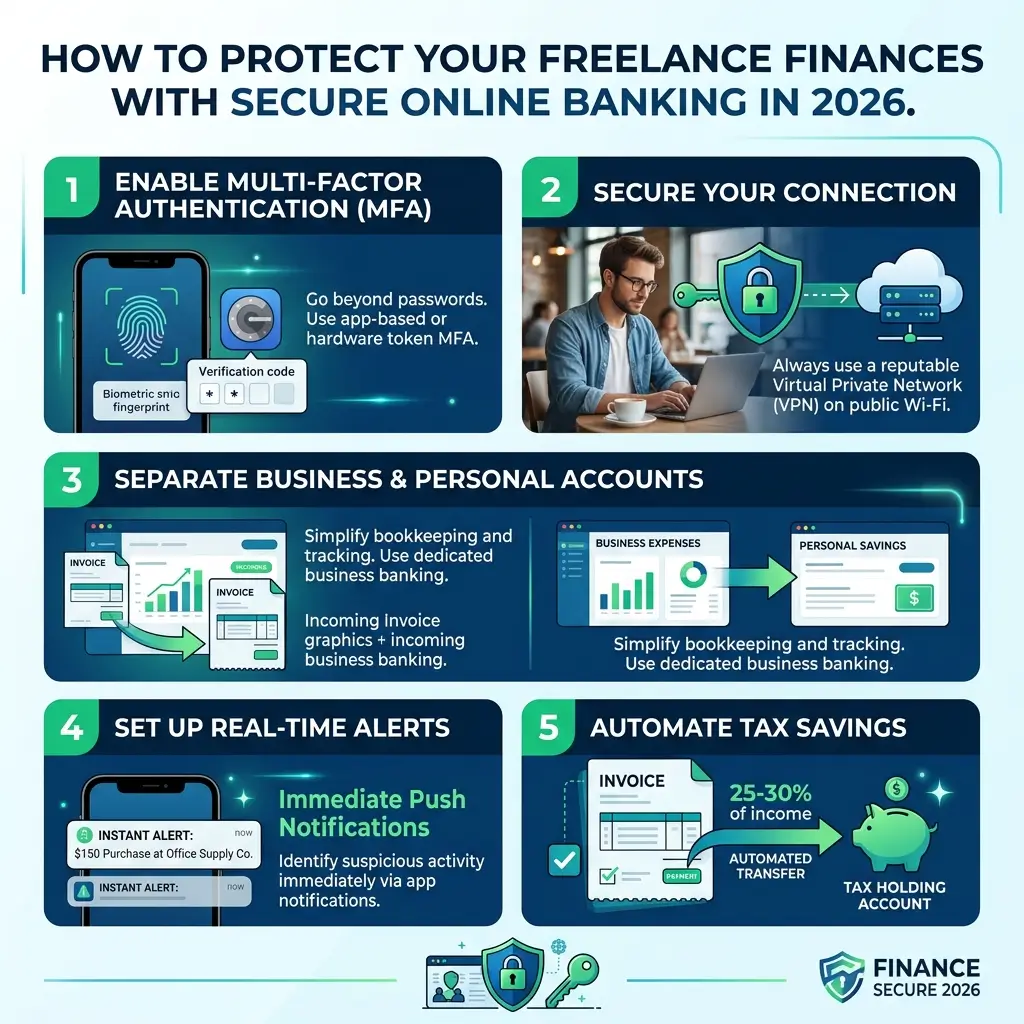
Important Security Features to Look For
Choose banks that offer:
- Two-factor authentication (2FA)
- Fraud monitoring
- Real-time alerts
- Encrypted access
- Secure login systems
Freelancers should never compromise on account security.
Regulatory Protection and Insurance
Check whether the bank is:
- Properly regulated
- Licensed in its operating jurisdiction
- Offering deposit protection or insurance where applicable
Reliable banking infrastructure matters long term.
Read Real Customer Reviews
Marketing pages rarely reveal actual operational issues.
Research reviews focusing on:
- Payment delays
- Customer support quality
- Account freezes
- International transfer experiences
Consistent negative feedback may indicate serious problems.
Step 5: Test the User Experience
Even if a bank looks impressive on paper, the real-world experience matters most.
A freelancer-friendly bank should simplify daily financial tasks.
What Good User Experience Looks Like
Freelancers should be able to:
- Send transfers easily
- Receive payments quickly
- Categorize expenses
- Export statements
- Manage cards instantly
- View balances in real time
Financial systems should reduce workload, not create additional complexity.
Try the Platform Before Fully Switching
If possible:
- Open the account
- Test small transactions
- Review transfer speeds
- Evaluate app performance
- Contact support with questions
Real testing often reveals issues marketing materials hide.
Online Banks vs Traditional Banks for Freelancers
Freelancers today usually choose between:
- Traditional banks
- Digital-first online banks
- Fintech platforms
Each option has advantages and disadvantages.
Traditional Banks
Advantages
- Physical branches
- Established reputation
- Large financial infrastructure
Disadvantages
- Higher international fees
- Slower innovation
- Poor FX rates
- More paperwork
Traditional banks often work best for freelancers needing local branch access.
Online Banks and Fintech Platforms
Advantages
- Lower fees
- Better mobile apps
- Faster transfers
- Multi-currency support
- Strong automation tools
Disadvantages
- Limited physical presence
- Variable customer support quality
Many international freelancers now prefer fintech-focused solutions.
Common Mistakes Freelancers Should Avoid
Many freelancers choose banks based on branding alone rather than actual functionality.
Here are the biggest mistakes to avoid.
Choosing Based Only on Marketing
Popular branding does not guarantee freelancer-friendly features.
Always compare actual:
- Fees
- FX rates
- Transfer policies
- Integrations
Practical functionality matters more than advertising.
Ignoring Hidden International Fees
Many freelancers focus only on visible charges while ignoring:
- FX spreads
- Intermediary bank deductions
- Conversion markups
These hidden costs often become the largest expense.
Overlooking Integration Features
Strong integrations save enormous administrative time.
Freelancers should check compatibility with:
- Accounting software
- Invoicing tools
- Payment processors
Automation improves efficiency significantly.
Not Testing Customer Support
Poor support becomes a major problem during:
- Account freezes
- Transfer issues
- Payment delays
Responsive customer service is essential for freelancers relying on online income.
Using Personal Accounts Instead of Business Accounts
Dedicated business banking creates:
- Cleaner bookkeeping
- Better tax organization
- Professional financial management
Mixing personal and freelance finances creates unnecessary confusion.
Best Practices for Choosing the Right Freelance Bank
Experienced freelancers usually follow several key principles.
Prioritize Functionality Over Branding
Choose banks based on:
- Workflow compatibility
- Fee structure
- International support
- Financial tools
not just popularity.
Compare Multiple Providers
No single bank is perfect for every freelancer.
Compare several options before committing.
Build Flexible Banking Systems
Many freelancers use more than one financial provider.
For example:
- One primary bank
- One multi-currency platform
- One payment processor
Diversification improves flexibility.
Review Your Banking Setup Yearly
Freelance businesses evolve over time.
A bank that worked initially may become inefficient later as:
- Income grows
- International clients increase
- Currency needs change
Annual reviews help optimize costs.
The Long-Term Benefits of Choosing the Right Online Bank
A strong banking setup creates more than convenience.
It improves:
- Financial organization
- Profit margins
- International scalability
- Cash-flow visibility
- Tax preparation
- Operational efficiency
Freelancers with organized financial systems often scale more successfully into long-term businesses.
Final Thoughts
Choosing the best online bank for freelancers is not about finding the most famous brand or the flashiest mobile app. It’s about building a banking system that supports the way your freelance business actually operates.
The right online bank should help you:
- Receive payments efficiently
- Reduce unnecessary fees
- Manage international clients smoothly
- Organize taxes and bookkeeping
- Automate financial workflows
- Maintain strong security
Freelancers should prioritize low fees, strong digital tools, reliable customer support, and international payment flexibility over marketing promises.
Choosing carefully today can save significant money, reduce administrative stress, and improve financial stability for years to come.
In 2026, successful freelancers are not only skilled professionals.
They are also strategic financial operators who build systems designed for long-term growth.